
AI and Machine Learning
The Agent Relay: Why One AI Should Run Your Whole Customer Journey
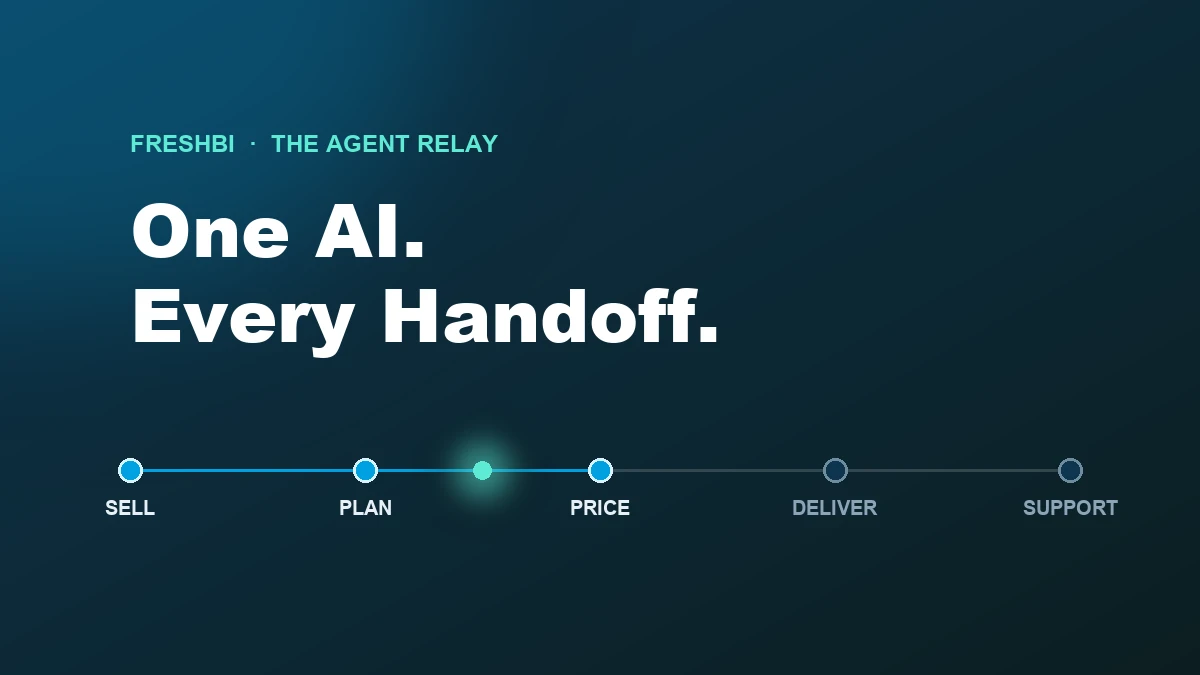
The Moment Everything Resets
You've just closed a deal. The sales conversation went well — the rep understood your business, your bottleneck, your timeline, even the political landmines you mentioned in passing. Then the calendar invite for "kickoff" lands, and you're back to square one: a new face, a blank intake form, and the same questions you already answered.
Nobody designed this on purpose. It's just what happens when "sales" and "delivery" run on different tools, different people, and different memories. The context doesn't transfer — it evaporates, one handoff at a time.
Why This Keeps Happening
Most companies now have an AI tool at almost every stage of the customer journey: a chatbot on the website, a proposal generator, a project management assistant, a support bot. Each one is genuinely useful. None of them talk to each other.
- The sales bot qualifies a lead and forgets everything the moment the deal closes.
- The delivery team re-discovers the same requirements in a kickoff call, because nothing from the sales conversation made it into their system in a usable form.
- The support bot meets the customer for the first time months later, with zero memory of who they are or what was promised.
Each tool is a point solution. Stitched together, they don't form a system — they form a relay race where every runner drops the baton before the handoff.
Introducing the Agent Relay
We think the fix isn't a smarter chatbot at any one of those stages. It's collapsing the stages into a single continuous intelligence — an Agent Relay — that carries full context across the entire customer journey instead of resetting at every handoff.
The metaphor is deliberate. In a relay race, the baton is what matters, not the runner. Swap runners as many times as you need — plan, price, deliver, support — as long as the baton (the context) never touches the ground. That's the difference between "we use AI in a few places" and an Agent Relay: the second one means nothing your business learns about a customer is ever asked for twice.
What This Actually Looks Like
In practice, an Agent Relay looks less like a chatbot and more like a single thread running underneath your whole business:
- First contact. A prospect lands on your site and talks to your AI agent. It doesn't just answer questions — it sells, because it actually understands what you offer well enough to match it to what they need.
- Internal handoff, instantly. The moment that conversation gets serious, your team is alerted in real time — not via a CRM field nobody reads, but with the actual context of what was discussed.
- Planning and pricing, automatically. The same information that sold the prospect becomes the input for a success plan and a proposal — built from what they actually said, not a generic template.
- Delivery, reserved on acceptance. The moment they say yes, real capacity on your delivery team gets reserved — no gap between "signed" and "started."
- Support, with full memory. Whoever — or whatever — supports that customer later has the entire history available, not a fresh start.
Nothing here is science fiction. Every piece already exists as a capability. What's new is refusing to let the pieces forget each other.
Why This Isn't Just "More Automation"
It's tempting to file this under speed — and the Agent Relay is fast, because there's no re-discovery phase eating weeks off the front of every project. But speed is a side effect, not the point.
The real problem an Agent Relay solves is accountability across a gap. When sales and delivery run on disconnected systems, sales can promise things delivery doesn't know about, and delivery can miss things sales already flagged as critical. A single continuous agent can't do that to you — it's the same intelligence on both sides of the handoff, which means there's no gap for a promise to fall into.
What's Next
This is the first in a series digging into each leg of the relay: what actually happens at the sales-to-planning handoff, how an agent prices work it didn't just estimate but actually understands, what it means for a proposal to reserve real delivery capacity the second it's accepted, and why the agent that sells you should be the same one that supports you for the life of the relationship.
If you're still stitching together five disconnected AI tools and calling it a strategy, that's exactly the gap the Agent Relay is built to close.